With the Iran war disrupting traditional energy supply routes and the West seeking to lessen reliance on Russian transit networks, Trans-Caspian corridors have again emerged as a focus of international diplomacy and investment.
Several distinct regional networks gained increased attention from global players at the Baku Energy Week earlier this month, including a subsea green electricity link and the Trans-Caspian International Transport Route, also known as the Middle Corridor.
But prospects for another key project, the long-delayed Trans-Caspian Pipeline (TCP), remain in doubt, languishing in a geopolitical deadlock since 1999, although it does have its backers still dreaming of a fresh route for natural gas from Turkmenistan and other Central Asian nations.
SEE ALSO:
How Iran's Hormuz Blockade Chokes Global Trade Beyond Oil And Gas
By bridging the Caspian Sea from Turkmenistan to Azerbaijan, the TCP would deliver Turkmen and other countries' natural gas directly into the Southern Gas Corridor, a mega-pipeline network stretching across Turkey to link with Greece, Italy, and the wider EU market.
Russia, Iran Bypassed, As China Maneuvers
The TCP has met resistance from Russia and Iran, which would be bypassed in the project. Chinese geopolitical and energy maneuvering only complicates the matter further.
But a key missing piece of the puzzle remains the reluctant supplier of the natural gas that would largely flow throw the pipeline: Turkmenistan.
Analysts say Ashgabat is not refusing to participate in the project but practicing strict strategic neutrality.
It wants to diversify via the proposed TCP but requires ironclad Western economic commitments before risking a major backlash from its powerful neighbors in Moscow and Tehran.
Conceived by the US, Bechtel, and General Electric in 1999, the original TCP was a $5 billion-plus megaproject designed to pump 32 billion cubic meters (bcm) annually.
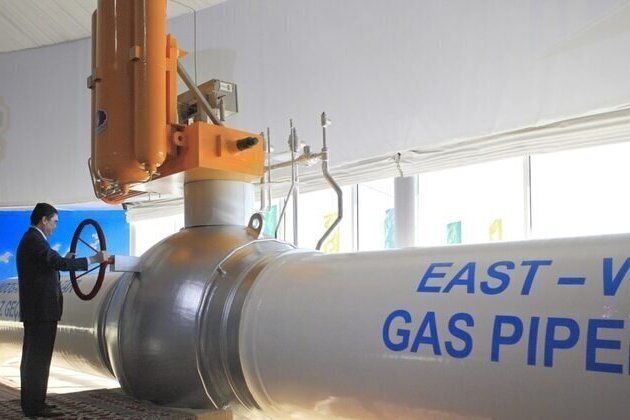
Turkmenistan took it so seriously that it spent $2 billion completing its onshore East-West Pipeline in 2015. The line was built to feed 30 bcm from its massive Galkynysh field to the Caspian coast for a subsea link that never materialized, blocked by Russia-Iran geopolitics, European financing hesitation, and Ashgabats pivot to China.
Fierce legal resistance from Russia and Iran, extreme costs, and the EU's green shift ultimately tore up the original blueprint. To rescue it, backers proposed a "lighter" 1012 bcm "interconnector" costing just $500-$800 million.
In an interview with RFE/RL, John Roberts, a nonresident senior fellow at the Atlantic Councils Global Energy Center, argued that the downsized Western target for Turkmen gas fails to justify the immense geopolitical risk.
The question for the Turkmens is the same as ever. Is it worth potentially offending Russia for a system of, say, 10 bcm?"
"Whereas it would definitely be worth offending Russia for a system of 30 bcm," he said.
A view of the Caspian Sea from Turkmenistan.
"So, the issue is, if 30 bcm is out for sheer financial reasons and complexity, is a 10 bcm system on the cards in terms of Azerbaijan, the companies, everybody else, including the United States, telling the Turkmens, this is available, do you find it acceptable?"
On May 29, Turkmen Foreign Minister Rashid Meredov met US Secretary of State Marco Rubio in Washington. The State Department's direct readout explicitly backed a westward transit path.
Secretary Rubio expressed strong US support for diversifying Turkmenistans natural gas exports through Trans-Caspian routes," the readout stated.
During a visit to Turkmenistan on June 9, Sarah Rodgers, US under secretary of state for public diplomacy, reiterated Rubio's sentiments, saying that with the world's fourth-largest reserves of natural gas, "we want the best for Turkmenistan in terms of developing and exporting those resources."
In stark contrast, the Turkmen embassy's statement avoided the phrase "Trans-Caspian Pipeline" entirely.
Reflecting Ashgabat's calculated policy of permanent neutrality, its statement leaned toward more on generic phrasing, noting only that particular attention was paid to cooperation in trade and economic affairs, energy, transport, and connectivity...[and] the importance of expanding mutually beneficial partnership, including in the areas of energy security and diversification of energy supply routes.
Chinas Strategic Leverage
Tired of waiting for a Western breakthrough, Turkmenistan is hedging its bets and casting its eye toward the East.
In April 2026, Ashgabat signed a massive $5.1 billion, four-year deal with Chinese state-owned CNPC to expand the giant Galkynysh field, adding 10 bcm of annual capacity destined for the upcoming Line D pipeline to fulfill its long-term goal of shipping 65 bcm to China annually.
SEE ALSO:
Central Asia Emerges As Strategic Energy Player Amid Oil Crisis
On May 27, Meredov made a deliberate stop in New York to meet visiting Chinese Foreign Minister Wang Yi, explicitly reassuring Beijing that Turkmenistan stands ready to advance direct natural gas projects with China.
China remains Turkmenistan's largest buyer, yet exports have stagnated at just over 30 bcm annually for years.
The Atlantic Councils Roberts said he believes this stagnation serves a deliberate purpose for Beijing.
Beijing can regard Turkmenistan as an asset that it could use and develop at any point it wishes. This gives China a very, very strong bargaining card when it comes to negotiating terms for gas import from Russia.
As Moscow aggressively seeks alternative export markets to offset Western sanctions, Beijing is attempting to use its untapped Central Asian options to extract steep pricing concessions from Russia.
Until those multibillion-dollar talks settle, Roberts argues, China is keeping Turkmenistan idling.
They're keeping Turkmenistan in their back pocket, as it were -- a card to be played as and when necessary.
SEE ALSO:
Rooftop Raids: Turkmenistan Cracks Down On Starlink Users
Too Many Superpowers
China is not the only heavyweight complicating the pipeline's future.
Alongside Russia, Beijing's deep regional influence creates a crowded superpower landscape that Anvar Khusainov, a former Uzbek oil and gas minister and deputy chairman of Uzbekneftgaz, states is keeping the TCP in limbo.
While Khusainov calls the TCP "one of my dreams" and "a very promising project," he warns it is trapped.
"The interests of the Russian Federation are right in the middle of this. Because there are so many massive and numerous players involved -- China, Russia, the US, the EU, Turkey, Azerbaijan -- there is a profound ambiguity and uncertainty at the center of it."
Yet, Khusainov retains long-term hope.
It will certainly be implemented and will become a mega-project of immense regional economic cooperation.
To make that dream a reality, Roberts believes that Ashgabat needs two baseline conditions.
SEE ALSO:
Iran War Sends Economic Ripples Through Central Asia, Turkmenistan Most Exposed
"One, obviously, a good commercial return of their own, and two, some kind of security guarantee in effect from the United States," Roberts said, without specifying the kind of protection Ashgabat would require.
While Washington's current leadership has shown a renewed interest in the region, Roberts remains skeptical about the depth of that commitment.
"Certainly, the Trump administration has pushed Central Asian energy connections much more strongly than many other recent US administrations."
"But whether they're prepared to provide the kind of security that Turkmenistan in particular would wish to have, that's a different question.... If it did feel that, I think we would have a Trans-Caspian pipeline."
Still, not everyone has given up on the TCP, especially Turkey, which is seeking to become an indispensable European energy hub.
In a message delivered on his behalf at the Baku energy event's opening, Turkish President Recep Tayyip Erdogan stressed: "There are significant opportunities ahead of us to further develop our cooperation on the export of Turkmen gas via Azerbaijan and Turkey."
Turkish Energy Minister Alparslan Bayraktar suggested that political momentum is finally building to make the project a reality. "There were statements that the time has come for Turkmen gas to reach Turkey and Europe through Azerbaijan.... Perhaps we are now at a point where everyone is ready to say yes."
Can The Dream Of A Trans-Caspian Pipeline Be Revived?
Share
Copy link
Facebook
X (Twitter)
LinkedIn
Email
Share
Share
Copy link
Facebook
X (Twitter)
LinkedIn
Email
Share
Follow us
Facebook
X (Twitter)
Youtube
Instagram
Follow us
Print



 Share
Share
 Tweet
Tweet
 Share
Share
 Flip
Flip
 Email
Email